



Living in Ontario, drivers are typically prepared when winter season rolls around, installing snow tires, maintaining distance, and when possible, staying off the roads. But are we prepared for other seasons when rain, summer heat, fog, freezing rain, and even drought-dry roads play a measurable role in driving conditions? Collision data indicates increased risk in every season for different reasons. Understanding these patterns is essential for all drivers on Ontario’s extensive road network.
So, the question becomes: Does weather make Ontario roads more dangerous? The answer is yes, with some important nuances that might surprise you.
Ontario’s Road Safety Baseline: 2023 and 2024
Before looking at how weather affects collisions, it helps to see how many crashes happen on Ontario roads overall.
According to the Preliminary 2024 ORSAR:
- 27,854 total fatal and personal injury collisions occurred in Ontario in 2024
- 562 were fatal collisions; 27,292 were personal injury collisions
- 617 persons were killed and 37,952 were injured
- The fatality rate was 3.82 persons killed per 100,000 population
The year prior tells a similar story. The Preliminary 2023 ORSAR recorded:
- 28,160 total fatal and personal injury collisions
- 584 fatal collisions and 27,576 personal injury collisions
- 641 persons killed and 38,007 persons injured
- A fatality rate of 4.05 per 100,000 population
In these two years combined, there were almost 56,000 crashes causing death or injury, over 1,200 deaths, and more than 75,000 injuries. This shows the scale we need to consider when looking at how weather plays a part.
Monthly Collision Patterns by Season
The ORSAR monthly collision tables give a clear view of how weather and seasons affect Ontario roads. While the data does not list weather as a separate cause, the monthly pattern of collisions still tells us a lot.
2024: Fatal and Personal Injury Collisions by Month
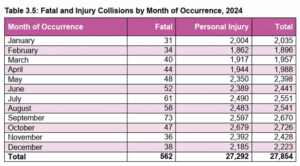
(Source: Preliminary 2024 ORSAR, Table 3.5)
2023: Fatal and Personal Injury Collisions by Month
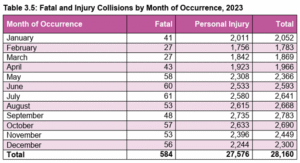
(Source: Preliminary 2023 ORSAR, Table 3.5)
There are two main findings from these two years of data.
First, winter is not the deadliest season. In both 2023 and 2024, the highest number of collisions happened in July, August, September, and October. For example, September 2024 had 2,670 collisions, more than any winter month. September 2023 also had the most collisions at 2,783.
Second, February had the fewest collisions in both years. In 2024, there were only 1,896 collisions in February, and in 2023, just 1,783. This is likely because people are more aware of the risks and take extra precautions while driving in the winter, such as avoiding the roads in bad weather, taking extra caution when driving in poor conditions, and being more cognisant of those around them.
However, fatal collisions show a different pattern. In January 2023, there were 41 fatal crashes, one of the highest monthly numbers that year. In 2024, July had the most fatal collisions at 61. This means that while the total number of crashes is highest in late summer and fall, the risk of fatal crashes is spread out and can spike in both winter and summer, but for different reasons.
What the Canada-Wide Data Tells Us About Adverse Weather
The Canada National Collision Database, as compiled and cited by Transport Canada, provides the clearest direct measurement of adverse weather’s contribution:
- From 2002 to 2021, an average of 18.7% of all traffic collisions in Canada each year occurred under conditions of adverse weather, including rain (9.5%), snowfall (6.5%), and freezing rain, sleet, or hail (0.6%), among other conditions.
- An additional 789 collisions (0.8% of all collisions) and 10 fatal collisions in 2021 occurred specifically during freezing rain, sleet, or hail conditions.
This means that about one in five crashes in Canada happens during bad weather. Rain is the biggest weather factor, even more than snow. Snow makes up 6.5% of crashes, but since it only happens in a few winter months, it creates a higher risk during those times.
While these numbers are for all of Canada, with Ontario’s snowy winters, spring ice storms, and summer thunderstorms, it is likely Ontario matches the national average for weather-related crashes.
How Weather Conditions Affect Driving in Ontario
Rain, heat, fog, freezing rain, and dry roads can each effect driving conditions. Knowing the impact of these weather conditions can help prepare you for travelling and ensure extra precautions are taken when necessary.
Rain
Rain can reduce friction on the roads and reduce visibility. When pavements are wet, drivers must increase braking distance by roughly 25-100% compared to dry pavement.
Hydroplaning can happen in wet conditions as car tires cannot push water away fast enough, and water will lift the tire partly or fully off the road. When that happens, steering and braking become less effective.
During periods of rain, it is important to drive a speed that is appropriate for the conditions and maintain a safe distance from others to ensure proper braking time.
Extreme Heat
Conditions that impact visibility are more commonly known to cause unsafe driving conditions, but even temperatures can cause road conditions to change.
In high temperatures, asphalt may soften, and tires can heat. This causes tire pressure to rise and stability to be reduced. A common issue during hot weather is an increased risk of tire blowouts from over heating.
Fog
Fog has a large impact on visibility, reducing visibility to under 100 meters. During periods of fog, there have been increases in chain-reaction collisions. There is also an increase in glare as headlights reflect off water droplets.
During episodes of fog, it is important to make sure your headlights are on, you are maintaining a safe distance from those around you, and you may want to consider driving with your hazards on to ensure you are visible.
Freezing Rain
When there is freezing rain, tire-road friction drops substantially, and you may need up to 10 times longer to break. Because of the slick conditions, vehicles may slide even at low speeds.
While anti-lock brakes may help in these situations, traction is still very limited. Because of this, driving slower than normal and keeping large distances between cars in front of you is crucial.
Drought-Dry Roads
When roads have been dry for long periods of time during periods of drought, it can seriously impact driving conditions. Dust and loose particles reduce tire grip, and oil buildup accumulates during long dry periods. Because of the buildup of dust, dust storms can cause reduced visibility like that of fog.
The first rain after periods of drought causes severe risks as the roads will become slippery when oil mixes with water. During this time crash rates rise noticeably because roads become temporarily slick before rainfall washes contaminants away.
Connecting the Data: What Drives the Monthly Patterns
Looking at both the ORSAR monthly data, a clear pattern emerges:
- Late summer and fall (August to October) had the most crashes in Ontario in both 2023 and 2024. During this time, people drive more, take longer trips, and there are more daylight hours. Early fall brings more rain and shorter days, and drivers may not have adjusted to the changing conditions yet. ORSAR data shows September had the most injury collisions in both years.
- Winter (December to February) has fewer total crashes, but still a significant number of fatal ones. The national data shows that 18.7% of crashes happen in bad weather, with most snow and freezing rain in these months.
- Spring and early summer (May to July) saw more crashes, presumably as the days became longer and people started driving more. In 2024, July had the most fatal crashes at 61, the highest for any month in either year. More recreational driving, more motorcycles (with 92 deaths in 2024 and 85 in 2023), and longer trips all add to the summer peak in fatalities.
The Chronic Nature of the Hazard
Bad weather is not just about big storms. It is a constant risk that builds up over many regular commutes and daily trips all year long.
Ontario gets rain in every month, and freezing rain, ice pellets, and blowing snow happen for four to five months each year in most areas. Fog is common along lakes and rivers all year. This is normal weather for Ontario, but both national data and research show that it raises the chance of crashes and makes injuries worse when they happen.
Drivers are aware of the risks of driving in winter conditions, but it seems they let their guards down in what is perceived as “normal” weather conditions. It is always important to be aware of the potential risks when driving and different precautions that could be taken to ensure your safety and the safety of those around you.
If you or a loved one have been hurt in a collision, having experienced legal representation is important to ensure you receive the compensation you are eligible for. If you’ve been injured in a weather-related collision in Ontario, contact our personal injury lawyers for a free consultation.